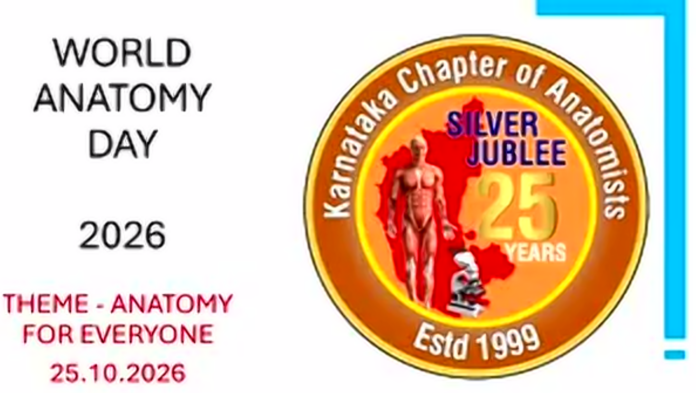
BENGALURU — In a major academic gathering marking both global morphological science and a regional milestone, the Karnataka Chapter of Anatomists (KCA) celebrated World Anatomy Day 2026 at the historic Cauvery Hall, Bangalore Medical College and Research Institute (BMCRI). The hybrid convention, which brought together senior anatomists, clinicians, and medical educators physically and virtually, formally ushered the association into its 26th year of leadership following a quarter-century of service since its inception in 1999.
Convened under the International Federation of Associations of Anatomists (IFAA) theme, “Anatomy for Everyone,” the sessions called for dismantling the historic departmental silos that have kept morphological sciences isolated inside first-year dissection halls.
Honoring the Foundational Legacy
World Anatomy Day commemorates the passing of Andreas Vesalius in 1564, the Renaissance physician whose landmark 1543 treatise De Humani Corporis Fabrica challenged Galenic dogma and established direct human dissection and scientific inquiry as the bedrock of medicine.
Opening the assembly, KCA President Dr. Ashwini N.S. reflected on the chapter’s journey, honoring Founder President Prof. Dr. S. Kantha. Dr. Ashwini emphasized that anatomy has progressed from traditional dissection to virtual platforms, structural variations, and molecular genetics, maintaining that the discipline remains a lifelong clinical gateway for surgeons, radiologists, and allied healthcare professionals alike.
Delivering the preamble, Dr. Vidya C.S. underscored the role of whole-body donors—revered as medical students’ “silent mentors” whose selfless gifts sustain medical training—quoting the Sanskrit adage Shariram Adhyam Khalu Dharma Sadhanam to remind attendees that the physical body remains the primary instrument for fulfilling life’s obligations.
“Knowing the Body to Understanding Humanity”
Delivering the keynote address, Dr. Pravin B. Iyer, Additional Professor of Anatomy at Seth GS Medical College & KEM Hospital, Mumbai, and Co-Director of the GSMC-FAIMER Regional Institute, challenged educators to transition from mere factual recall to clinical applicability and empathetic engagement.
Drawing from his extensive experience in Competency-Based Medical Education (CBME), Dr. Iyer argued that anatomy should serve as an integrated thread throughout medical training rather than an isolated pre-clinical hurdle:
- Clinical Interdependence: Routine clinical decision-making relies directly on functional spatial orientation—from navigating neurovascular structures during central venous catheterization to safely decompressing pleural effusions or localizing cerebrovascular accidents.
- Cross-Specialty Collaboration: Dr. Iyer highlighted institutional models where anatomists partner with cardiology, neurosurgery, and plastic surgery departments to co-teach complex procedural topography and flap elevation to senior residents.
- Community and Body Literacy: Anatomical education must extend beyond medical schools to address public health literacy, school outreach programs, and ethical stewardship surrounding body donation.
“Anatomy is not just about the body we study; it is about the body we live in,” Dr. Iyer remarked, urging teachers to dismantle learning barriers and integrate clinical problems into routine lectures.
Challenging Historical Dogma: Are We Teaching the Anatomy of Everyone?
Addressing the convention from the United Kingdom, Dr. Doris George Yohanan, Lecturer in Anatomy at the University of Exeter Medical School, delivered a probing critique centered on inclusivity, representative morphology, and curricular relevance.
Evoking the iconoclastic spirit of Vesalius, Dr. Yohanan posed two central questions to medical educators:
- Are We Teaching the Anatomy of Everyone? Historically, anatomical curricula and classic reference atlases have disproportionately mirrored a standard “white, lean, adult male” baseline. Dr. Yohanan underscored how this systemic omission leads to clinical biases and disparities:
- Gender representation: The delayed adoption of female CPR training mannequins has contributed to hesitation and poorer resuscitation rates for female cardiac arrest victims in public settings.
- Racial and skin diversity: Conventional descriptions like the “red reflex” during fundus examinations fail to represent normal Asian or Black retinal pigments (which appear orange or deeper), prompting modern pedagogical shifts toward the inclusive term “fundal reflex test”.
- Body habitus: Educational emphasis on lean models leaves trainees unprepared to palpate arterial pulses, locate cardiac landmarks (such as the apex beat), or interpret chest imaging obscured by adipose tissue in patients with obesity.
- Are We Teaching Anatomy Relevant to Everyone? Dr. Yohanan urged institutions to continually audit the MBBS syllabus under the National Medical Commission (NMC) guidelines. He questioned whether archaic assessments—such as isolated dry-bone side determinations—prepare Indian Medical Graduates (IMGs) for frontline practice as effectively as cross-sectional CT/MRI interpretation, point-of-care ultrasound anatomy, or interactive physical surface examination.
The presentation highlighted modern approaches adopted at Exeter, including longitudinal teaching across clinical years, early integration of diagnostic imaging alongside radiologists, and the use of living anatomical models (LAMs) to reinforce surface palpation skills with informed consent.
Stalwarts Felicitated
The convention concluded with the felicitation of veteran anatomists who have shaped medical education across southern India:
- Sushruta Gold Medal Award for Excellence in Anatomy (Posthumous): Awarded to the late Dr. S. Srinivasiah for his 36 years of academic mentorship and artistic contributions to anatomical illustration. The award, instituted by KCA Vice President Dr. N.M. Suresh, was received by Dr. Srinivasiah’s family, including his son, Dr. Asha Kiran, Principal of the Sambhram Institute of Medical Sciences.
- Prof. Dr. Jayanthi K.S.: Former Professor and Head of Anatomy at Kempegowda Institute of Medical Sciences (KIMS), Bengaluru, recognized for nearly three decades of undergraduate and postgraduate teaching and contributions to histological literature.
- Prof. Dr. C.R. Gopal: Former Professor and Head of Anatomy at BMCRI, commended for his extensive leadership in gross anatomy, neuroanatomy curriculum planning, and museum curation.
Closing the proceedings, Joint Secretary Dr. Vasudha Kulkarni delivered the vote of thanks, acknowledging Treasurer Dr. Ashwini, organizing coordinator Dr. Akhila, and BMCRI for hosting the convention. Delegates pledged to carry forward the mandate of World Anatomy Day 2026—committing to make anatomical sciences more inclusive, clinically grounded, and deeply humanistic.